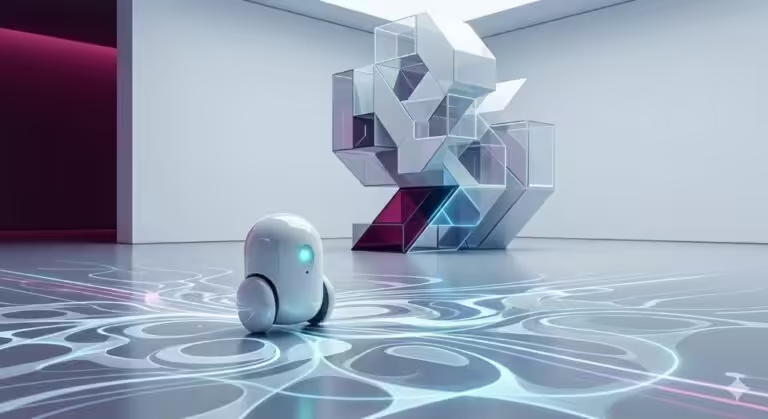

“Immersive” is an overused word. In digital aesthetics—games, virtual production, spatial interfaces, and large-format installations—it refers to experiences that convince the senses of scale, atmosphere, and presence. Achieving immersion is not only a matter of resolution; it is coherence across lighting, motion, sound, interaction latency, and narrative framing. This article explores how designers build believable digital landscapes, where AI assists, and where restraint separates art from nausea.
Layers of immersion (a useful decomposition)
Sensory fidelity: frame rate, HDR handling, anti-aliasing, audio spatialization.
Behavioral responsiveness: worlds react to input with consistent rules.
Narrative framing: the mind accepts stakes—without story, even beautiful vistas feel like wallpaper.
Teams often over-invest in the first layer while neglecting the third.
Real examples (patterns)
Virtual production on LED volumes:
Filmmakers combine camera tracking with parallax-correct backgrounds. Immersion breaks when latency creeps—actors feel the lag before audiences do. Fixing immersion is often milliseconds, not megapixels.
Open-world games:
Large landscapes succeed when biome rules and travel pacing align. Players forgive lower poly counts if audio design and lighting sell the place.
Brand installations:
Museum-scale rooms use projection mapping with calibrated geometry. AI can assist content iteration, but on-site calibration determines whether the illusion holds at oblique angles.
Comparisons: realism vs stylization
| Approach | Strength | Weakness |
|---|---|---|
| Photoreal | Immediate recognition | Uncanny valley when slightly wrong |
| Stylized | Forgiving; iconic | Harder to maintain consistency across assets |
| Hybrid | Flexible | Requires strong art direction |
Who should use what
- Training simulators → bias realism where metrics depend on it.
- Consumer brands → stylization can be more memorable than realism.
- Art projects → push hybrid; disclose generative pipelines when relevant.
Pros and cons
Pros
- Emotional impact; spatial storytelling possibilities
- New distribution channels (XR, webGPU experiences)
Cons
- Simulator sickness if motion/FOV mishandled
- Cost of asset production and QA
- Accessibility barriers without alternatives
AI’s role: asset speed vs coherence
Generative tools accelerate concept art and texture variation, but immersive worlds need locked style guides—palette limits, shader families, LOD rules—or everything feels like a mood board. The best pipelines use AI in pre-production and enforce human gatekeeping before assets enter runtime builds.
Latency, motion, and the body’s vote
Immersive landscapes fail in subtle ways: camera sway mismatched to walking speed, FOV changes without easing, footstep audio desynced from surfaces. Players may not articulate the issue—they simply quit. Profiling end-to-end latency across input, simulation, render, and display matters more than adding another biome variant.
Sound design is half the landscape: wind layers, distant traffic, birds with plausible spatial cues. Visuals draw the eye; audio convinces the body.
Production pipelines: what studios actually argue about
Arguments are rarely “which renderer is best.” They are about asset ownership, naming conventions, LOD transitions, and nightlies that do not break shaders. Immersive aesthetics are systems; hero shots are marketing, not the product.
Why trust this guide
InsightEra treats this article as independent editorial analysis, not vendor promotion. We separate observed patterns, composite examples, and opinionated recommendations so readers can judge evidence and context clearly.
Author accountability and editorial method
Author: Sarmad, Founder & Lead Author at InsightEra.
Each material update is reviewed for technical plausibility, operational usefulness, and risk transparency (privacy, security, and maintenance tradeoffs). We update guidance when facts change and keep recommendations practical for operators.
For publication-wide standards, see:
– About
– Editorial Policy
– Disclaimer
FAQs
What breaks immersion fastest?
Inconsistent physics and audio—not a single bad texture.
Is 8K necessary?
Rarely; contrast, motion, and audio dominate perceived fidelity at typical viewing distances.
How do we make immersive work accessible?
Offer non-immersive modes: alternative navigation, reduced motion, subtitle richness, and brightness controls.
Museums, brand worlds, and the ethics of spectacle
Large-scale “immersive” exhibitions—projection-mapped rooms, mirrored infinity floors—draw crowds but raise questions about ticket economics, artist compensation, and environmental costs of touring rigs. Ethical production means clear credit for collaborators, sustainable touring practices where possible, and accessible ticketing (captioning, seating, sensory-friendly hours).
Retail tie-ins: some brands build immersive pop-ups for Instagram virality. The honest metric is not shares—it is repeat purchase and brand recall weeks later. Immersive without product truth feels hollow fast.
When immersion fails: debugging checklist
- Measure motion-to-photon latency on target hardware.
- Validate audio occlusion with headphones used by real users.
- Check contrast in bright rooms—HDR highlights are not universal.
- Test with users who get motion sick; prioritize their feedback over aesthetic pride.
Related on InsightEra
- Organic shapes in modern digital architecture
- AI motion techniques in abstract digital design
- Parametric design in small studios
- AI-driven lighting in modern interior design
- AI for online businesses
InsightEra publishes independent analysis. XR experiences may involve health considerations—consult professionals where appropriate.
Takeaway: immersion is synchronization—when senses agree, belief follows; when one channel lies, the spell breaks.