
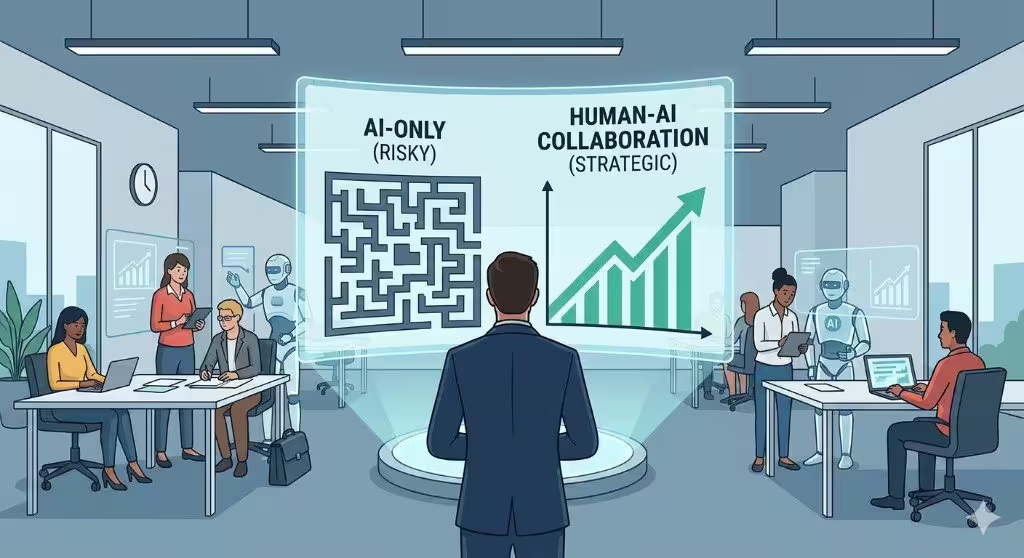
Creative agencies face a credibility trap: clients want speed and originality simultaneously, while tools promise infinite variations. This anonymized case study follows a twelve-person US agency (branding + motion + web) as it integrates AI into research, concepting, and production—without letting outputs flatten its visual voice. Names are changed; numbers are realistic composites.
Context: the business model
River & Rail Studio (pseudonym) serves mid-market B2B clients with $40k–$250k engagements. Revenue depends on margin per hour and repeat work. Junior talent is talented but expensive to train; seniors are overloaded on creative direction and client diplomacy.
Problem statement
Pitch cycles tightened; clients expect more concepts earlier. The team experimented with generative image tools and found two issues: outputs looked generic, and reviewers could not explain why a direction fit strategy. Craft was not only pixels—it was argument.
What they adopted (and what they refused)
Adopted
- Research summarization for competitor scans—humans verify claims.
- Mood-board generation under locked palettes defined by creative leads.
- Copy drafting for internal rationales and first-pass microcopy—brand editors finalize.
- Code assist for prototyping interactive sketches.
Refused (for now)
- Client-facing generative imagery without art direction
- Automated proposals that quote prices without partner review
Workflow changes that mattered
They created tokens: palette caps, typographic scales, motion easing families. AI outputs must pass token checks before review—reducing “almost right” drift. They also scheduled AI Tuesdays: a two-hour block to test tools calmly rather than during crunch weeks.
Results (honest, mixed)
- Pitch throughput up modestly; not 2×.
- Revision cycles down on web projects where prototypes accelerated alignment.
- Risk: occasional client assumption that “AI makes it cheap”—countered with process documentation showing senior time unchanged in Q/A.
Pros and cons of their approach
Pros
- Preserves creative authority
- Reduces grunt without pretending seniority is obsolete
Cons
- Tool subscription creep
- Staff training time is real
Who should copy this pattern
- Small creative shops with identifiable brand systems
- Teams willing to say no to client requests that confuse fast with free
Pricing and client education
When clients hear “AI,” some expect discounts. River & Rail responded with transparent pricing: concept counts, revision rounds, and senior review hours explicit in statements of work. They stopped apologizing for tools and started charging for judgment—which was always the product.
Risk register (what they actually fear)
- Style drift across accounts if juniors lean on defaults without critique.
- IP leakage if prompts include client secrets—policies ban pasting confidential briefs into unmanaged tools.
- Reputation hits if a deliverable slips past QA because “the model looked fine.”
Mitigations: checklists, two-person review on public-facing assets, and offline scratch work for sensitive sectors.
What they would do differently
Start tokenization earlier—brand systems were informal until year two of adoption. Earlier rigor would have saved rework on a handful of marquee campaigns.
Client communication template that reduced friction
The agency started each kickoff with a one-page “AI boundaries” brief: what would be automated, what remained senior-led, and which deliverables were always human-reviewed. This reduced misunderstanding about speed, pricing, and originality before revision rounds started. The operational lesson is simple: most conflicts blamed on tools are expectation failures that should have been handled in scope language.
Quality control rubric they operationalized
After several inconsistent deliveries, the team introduced a rubric with four scored dimensions: strategy alignment, brand consistency, execution quality, and risk exposure. Every draft had to pass a minimum score before client review. This looked bureaucratic at first, but it reduced revision loops because feedback became specific and repeatable rather than taste-driven arguments. The rubric also helped junior staff understand what “good” looked like in the studio context.
A second-order benefit was margin stability. When reviews are predictable, project managers can estimate review effort more accurately and protect utilization. The agency stopped treating quality as a heroic intervention by one creative director and started treating it as an observable process.
Staffing model and career ladder impact
Instead of replacing junior roles, the agency rewired them. Juniors spent less time on repetitive production and more time on research synthesis, reference curation, and preparing rationale drafts for senior review. That accelerated skill development because juniors were closer to strategic discussions earlier in their careers.
The leadership team also clarified promotion criteria: not “uses AI tools,” but “improves client outcomes while protecting brand standards.” This distinction mattered. Tool fluency changed every quarter; judgment quality remained the durable trait they wanted to reward.
FAQs
Did they fire juniors?
No—reallocated junior time to higher learning tasks; still hiring carefully.
What stack?
Intentionally omitted—principles age better than vendor names.
Related on InsightEra
- AI motion techniques in abstract digital design
- Modular devices and modern workflows
- Minimal web design and conversion
- Future of work: hybrid realities
- When AI-first is a mistake
Composite case for education—your mileage will vary.
Takeaway: craft survives when criteria are explicit and leads own taste.