Introduction
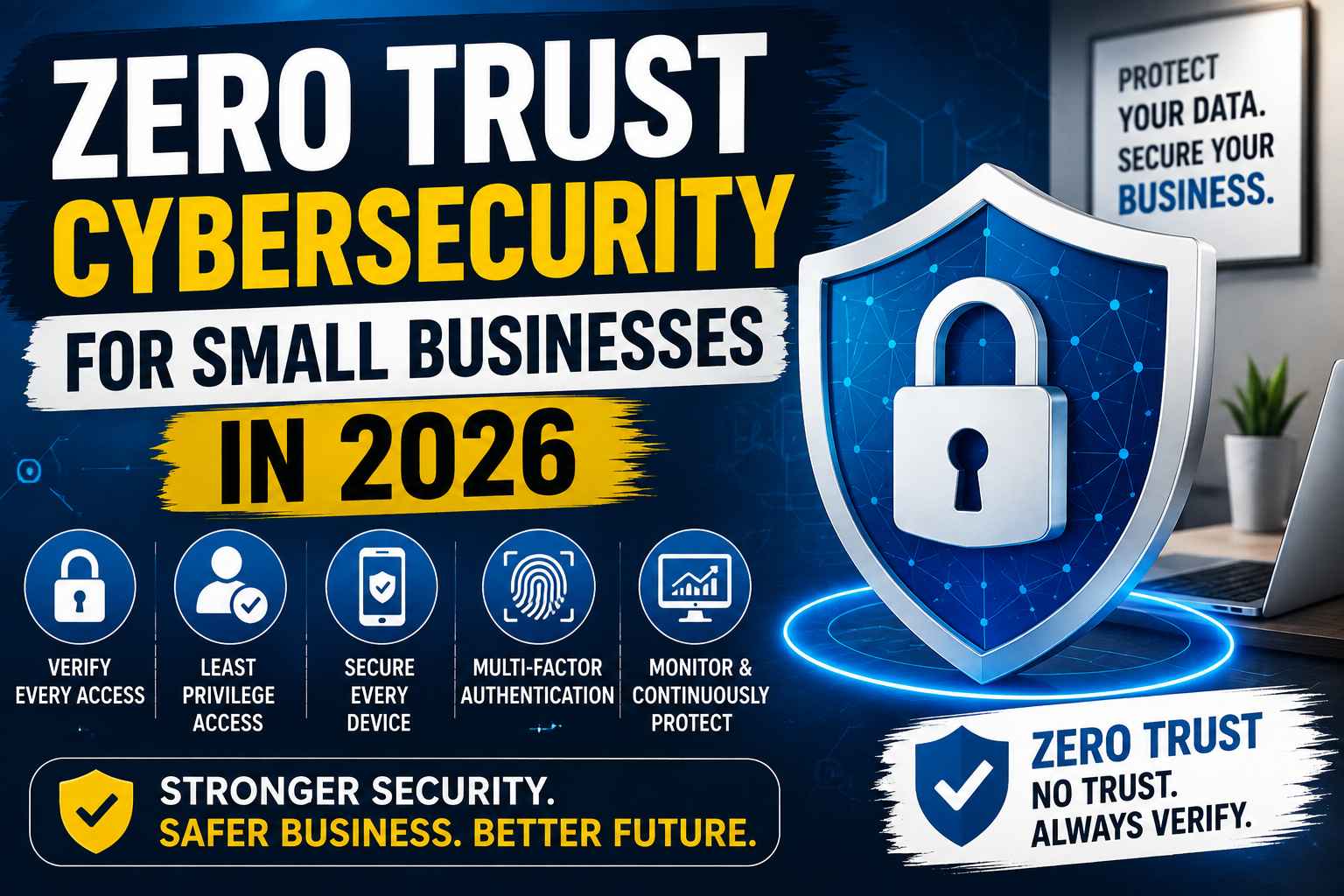
Zero Trust Cybersecurity for Small Businesses is no longer a challenge for large technology companies and multinational corporations only. By 2026, small businesses will rely on cloud applications, electronic payments, remote employees, smartphones, customer databases, and digital communications. Such growing reliance on modern technologies also implies that a mere compromise of an account, a password theft, and even one device vulnerability could create serious problems for business owners.
Powerful Zero Trust Cybersecurity for Small Businesses in 2026 Traditional security systems usually worked under the assumption that company network was protected. As long as an intruder managed to get inside a company’s network, he was considered more trustworthy than someone outside the network. In modern times, such assumption became outdated. Business employees might work remotely, application might run in the cloud, contractors would require temporary access, and company’s data could be accessed by different devices.
It is here when Zero Trust cybersecurity comes into play.
Powerful Zero Trust Cybersecurity for Small Businesses in 2026 Zero Trust is based on a simple assumption – there is no need to trust a user, a device, and even a connection simply because it is inside a certain network.
According to the National Institute of Standards and Technology (NIST), Zero Trust approach involves removal of implicit trust based on network location and focuses on users, assets, and resources. Prior to the access to enterprise resources, authentication and authorization take place.
Powerful Zero Trust Cybersecurity for Small Businesses in 2026 It should be stressed that Zero Trust cybersecurity for small businesses in 2026 does not imply the purchase of an expensive enterprise security system or reconstruction of company’s IT infrastructure from scratch.
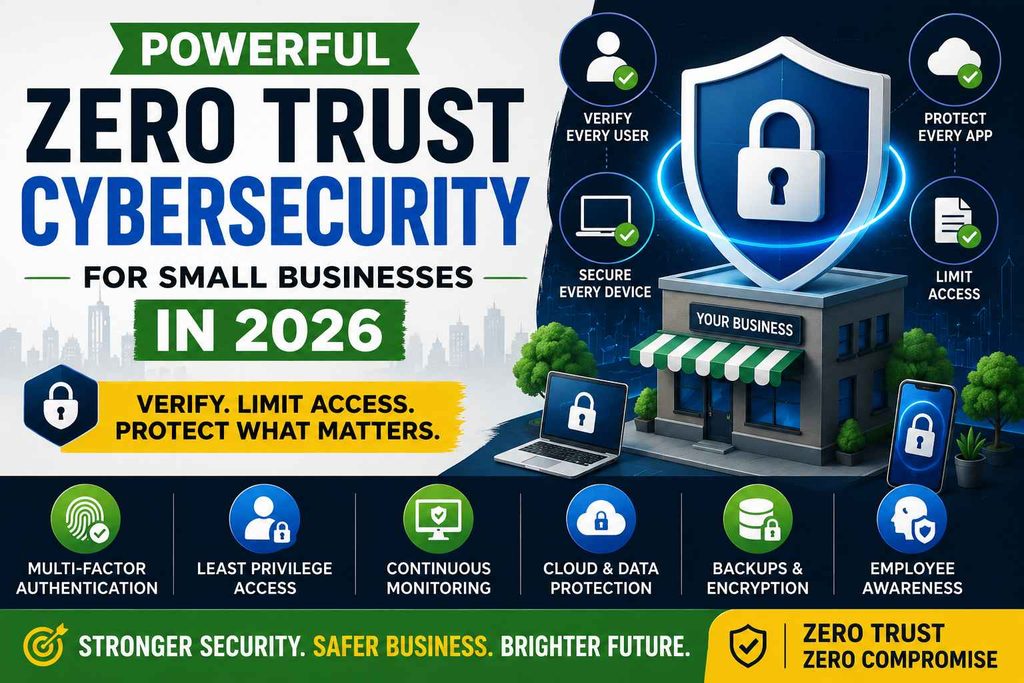
In order to adopt this technology, small business owners could start with multi-factor authentication, least privilege access, device security, software updating, strong identity management, regular backups, and monitoring.
Powerful Zero Trust Cybersecurity for Small Businesses in 2026 The current paper provides insights into Zero Trust, explains why it is important for small businesses in 2026, how it works, highlights its advantages and disadvantages, and reveals ways to implement Zero Trust technology without complicating cybersecurity in a small business.
What Is Zero Trust Cybersecurity?
Powerful Zero Trust Cybersecurity for Small Businesses in 2026 is a security paradigm based on the principle of continuous trust rather than trustworthiness by default.
Powerful Zero Trust Cybersecurity for Small Businesses in 2026 The traditional network model allows an employee to connect to the company network and gain broad access rights to all its resources.
Zero Trust operates differently.
The network does not ask:
Powerful Zero Trust Cybersecurity for Small Businesses in 2026 but rather:
It results in a more refined security approach.
The NIST Zero Trust Architecture focuses on securing the resources instead of securing network boundaries. It also takes into account contemporary circumstances when people are working remotely, organizations are using cloud technologies, and personal devices are accessing the company’s resources.
Powerful Zero Trust Cybersecurity for Small Businesses in 2026 In a small business, it would mean that an employee who is able to access his/her email cannot automatically access the accounting software, customer databases, or any other company files.
Access is granted on the basis of necessity. https://insightera.co/ai-for-small-businesses-2026/
Why Zero Trust Matters for Small Businesses
PowerZero Trust Cybersecurity for Small Businesses in 2026 Small businesses may have few employees and less IT budget than big firms.
But even small businesses may have valuable data like:
Customer information
Payment details
Employee data
Business agreements
Financial data
Usernames and passwords
Intellectual property
Information about suppliers
Company documentation
Thus, a cyber-attack will not only compromise a computer.
Powerful Zero Trust Cybersecurity for Small Businesses in 2026 It will be able to disrupt business operations, ruin customer relations, result in financial costs and force a company to recover its systems.
The Federal Trade Commission explicitly recommends implementing basic cybersecurity measures like password protection, software updates, backups, multi-factor authentication, access management, encryption and education of employees.
Powerful Zero Trust Cybersecurity for Small Businesses in 2026 Many of these basic security approaches are utilized in Zero Trust and are built on top of access control and identity management.
Core Concepts of Zero Trust
Powerful Zero Trust Cybersecurity for Small Businesses in 2026 Zero Trust is not one software solution.
It is a security strategy which involves several concepts.https://www.ftc.gov/business-guidance/small-businesses/cybersecurity
- Verify Access Requests
Powerful Zero Trust Cybersecurity for Small Businesses in 2026 The user cannot automatically gain access because he or she is on the company network.
Access should be granted based on identity verification and other relevant security criteria.
For instance, Powerful Zero Trust Cybersecurity for Small Businesses in 2026 an employee accessing business application via a new device may be required to undergo additional verification.
- Use Least-Privilege Access
Powerful Zero Trust Cybersecurity for Small Businesses in 2026 The employees should be given only necessary access.
For instance:
Powerful Zero Trust Cybersecurity for Small Businesses in 2026 Marketing staff can be provided with access to social media and marketing-related applications.
However, they do not need to have access to payroll records.
Similarly, an accountant can require access to financial systems but not necessarily to the company’s development environment.
Powerful Zero Trust Cybersecurity for Small Businesses in 2026 Such access minimizes possible damages from the use of the compromised account.
- Secure Devices
Powerful Zero Trust Cybersecurity for Small Businesses in 2026 Identity of the person is just one aspect of the security process.
Identity of the device which tries to access company resources is another important thing.
Powerful Zero Trust Cybersecurity for Small Businesses in 2026 Companies can set the following requirements:
Update of the operating system
Use of security software
Screen lock
Device encryption
Authentication
Use of approved applications
Even if the password of the employee is fine, the compromised device can become an access point into company’s systems.
- Multi-Factor Authentication
Powerful Zero Trust Cybersecurity for Small Businesses in 2026 Single passwords have become increasingly inadequate means of security protection.
Use of multi-factor authentication requires an extra layer of verification aside from passwords.
For instance:
password + authentication app or password + security key
Powerful Zero Trust Cybersecurity for Small Businesses in 2026 According to the FTC, companies should use multi-factor authentication for their employees, contractors and other persons having access to the company networks and devices.
For many small businesses MFA is one of the easiest and most valuable Zero Trust-aligned improvements to make.
Zero Trust Working Example in Small Business
Consider the case of a small e-business having ten employees.
The following services will be used by the business:
Google Workspace or Microsoft 365
Accounting software running on cloud platform
CRM Software
Payment gateway
Cloud Storage
Laptops belonging to the company
Without proper access control mechanisms, employees might find themselves having access to several services.
In a Zero Trust model, individual access control of employees will be considered.
For example:
Employee A – Marketing
Access:
Marketing platform
Social Media
Website Analytics
No Access:
Payroll
Accounting
Employee B – Accountant
Access:
Accounting platform
Financial Documents
Banks related applications
No Access:
Social Media management
Website development
Employee C – Programmer
Access:
Development Environment
Repositories
Documentation
No Access:
Payroll System
It ensures separation between various departments.
Zero Trust Architecture and Remote Working
Remote working has altered the approach organizations take towards security.
The employee could be accessing organizational networks from:
Home
A coworking office
Hotel
Airport
Other countries
A personal device
It is clear that the physical location of the employee does not necessarily determine if the access is to be trusted.
According to NIST, remote workers, BYOD environment, and cloud infrastructure are key considerations for going past network security perimeter.
Zero Trust architecture, as a result, becomes very important for businesses having geographically distributed teams.
Final Thoughts
Cybersecurity is becoming an essential part of running a modern business.
For small businesses, the challenge is not necessarily building the most advanced security system available. The bigger challenge is creating a practical system that protects important information without becoming too expensive or complicated.
Zero Trust offers a useful framework for achieving that goal.
Instead of automatically trusting users, devices, or network locations, Zero Trust encourages businesses to verify access, limit permissions, protect devices, monitor activity, and continuously evaluate security conditions.
For a small business in 2026, implementation can begin with simple steps.
Enable multi-factor authentication.
Remove unnecessary accounts.
Reduce administrator privileges.
Keep devices updated.
Back up important data.
Train employees.
Review permissions regularly.
Then gradually introduce more advanced controls as the company grows.
The biggest advantage of Zero Trust is not a particular software product. It is a change in security thinking.
Rather than asking:
“Is this person inside our network?”
businesses should ask:
“Does this person need access to this specific resource, from this specific device, under these specific conditions?”
That mindset can create a much stronger security foundation.
Zero Trust is not a magic solution, and it does not eliminate every cybersecurity risk. It requires planning, maintenance, employee cooperation, and appropriate technology. But when applied thoughtfully, it can help small businesses reduce unnecessary access and better protect their digital assets.
For organizations building their digital presence in 2026, cybersecurity should not be something considered after a problem occurs.
Build security into the business from the beginning, and make every access decision intentional.
Table of Contents