

InsightEra
  • Home
  • Privacy Policy
  • About
  • Editorial Policy
  • Disclaimer
  • Terms of Use
  • Cookie Policy
  • Contact
HomeData The US Data Privacy Patchwork: What Operators Actually Do (Without Pretending It Is Simple)

The US Data Privacy Patchwork: What Operators Actually Do (Without Pretending It Is Simple)

sarmad on March 24, 2026
Data Policy & governance
4 Min Read

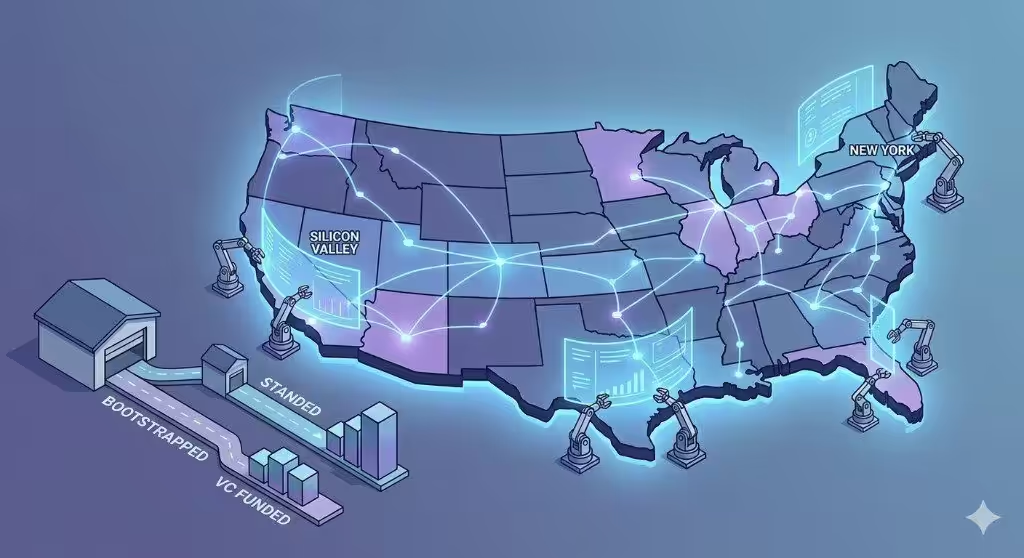
US privacy is not one law—it is a patchwork of state statutes, sector rules, contract obligations, and tort risk. For operators—especially ecommerce, SaaS, and services firms selling nationwide—the workable strategy is not “perfect compliance” on day one but credible progress: inventories, disclosures, vendor contracts, and trainable habits among staff. This article outlines practical moves mid-market teams take, compares baseline vs advanced programs, and flags common mistakes—without offering legal advice.

What “patchwork” means in weekly work

You might face: California’s CPRA-influenced expectations, Colorado/Virginia-style rights, biometric rules in Illinois and elsewhere, and kids’ privacy (COPPA) if relevant. Enterprise customers add DPAs, SOC2 questionnaires, and insurance riders. The workload is process, not a single checkbox.

Baseline program (many teams start here)

  • Data map: what you collect, why, where stored, who accesses.
  • Privacy notice aligned to practices (not aspirational).
  • Vendor review for subprocessors and DPAs where needed.
  • Employee training on phishing and secret handling—privacy failures are often human.

Advanced program signals

  • Records of processing and retention schedules with owners
  • Privacy reviews for new features before launch
  • Incident response runbooks and tabletop exercises

Comparison: SMB vs enterprise posture

Posture Strength Weakness
Lean Fast Fragile at scale
Structured Sell-upmarket Slower

Who should use what

  • SMB → lean but honest; avoid copying enterprise policies you will not operationalize.
  • Growth SaaS → invest earlier—security reviews gate revenue.

Pros and cons

Pros

  • Fewer surprises in diligence
  • Better customer trust

Cons

  • Cost and complexity
  • Overcollection of policies nobody reads—avoid theater

Employee training: the overlooked control

Privacy incidents often start with phishing or accidental CC lists. Training that is short, frequent, and tied to real scenarios beats annual checkbox theater.

International customers from a US storefront

Selling digitally means you may collect data from EU or UK residents. “We only ship US” does not automatically erase obligations—map flows honestly.

Cookies, pixels, and marketing tech

Even “simple” sites often run analytics and ads pixels. Disclose them; configure consent where required. Misconfigured tags leak data and destroy trust. A privacy program that ignores marketing stacks is incomplete.

Employee devices (BYOD) reality

Personal phones accessing company email create endpoint risk. Policies should cover MDM where appropriate, separation of work/personal data, and offboarding steps that actually happen—not theoretical HR memos.

DSAR readiness and evidence trails

Even lean teams should rehearse at least one data-subject request workflow end-to-end: intake, identity verification, system search, response timeline, and deletion exceptions. Practicing this once reveals hidden dependencies in CRM tools, support systems, and backups. Regulators and enterprise customers both look for evidence that processes are operational, not policy text sitting on a website.

Vendor governance that survives real audits

Most privacy failures in growth companies happen through third-party tools, not first-party intent. Build a simple vendor register that includes purpose of processing, data categories touched, subprocessor exposure, contract owner, and renewal dates. Review this register quarterly with legal and security stakeholders.

When a customer or regulator asks where personal data flows, this register becomes your operational memory. Without it, teams scramble through procurement inboxes and old contracts, which signals weak governance even if your intentions are good.

Retention schedules and deletion discipline

Retention is where policy language meets engineering friction. Define default retention periods per data type, then map which systems can actually enforce deletion automatically. Where automation is not available, create manual workflows with owners and deadlines.

Deletion discipline reduces breach exposure and lowers response burden during access requests. It also improves product trust because you can explain, concretely, how long information is kept and why that period exists.

Practical quarterly review cadence

Run a quarterly privacy review with product, legal, security, and operations. Confirm new tools, changed data flows, and unresolved incidents. Short recurring reviews outperform annual policy rewrites because they catch operational drift early.

Minimal compliance dashboard

Keep one internal dashboard with outstanding DSARs, overdue vendor reviews, unresolved incidents, and policy exceptions. Visibility creates accountability. Without visible backlog, privacy work gets postponed by louder priorities until a customer or regulator forces urgency.

Practical implementation note

To keep this actionable, run a 30-day execution cycle with one owner, one success metric, and one weekly review checkpoint. If outcomes are improving, scale carefully; if not, document failure causes before changing tools. This prevents strategy drift and turns content ideas into measurable operating decisions.

FAQs

Do we need a DPO?
Depends on scale and law—ask counsel.

Is “US-only hosting” enough?
Not necessarily—data can still be regulated by state of residents.

Related on InsightEra

  • AI regulation and governance
  • AI for online businesses
  • RAG for non-engineers
  • When AI-first is a mistake
  • The digital revolution in the USA

Not legal advice—consult qualified counsel.

Takeaway: privacy is operational integrity; start with truth in your notice and map.

sarmad on March 24, 2026 Data Policy & governance
previous article
Next article

Leave a comment Cancel reply

Your email address will not be published. Required fields are marked *

categories

  • AI
  • Architecture
  • Built environment
  • Business
  • Business & technology
  • Creative
  • Crypto
  • Data
  • Design & Technology
  • Digital
  • Digital art
  • Entrepreneurship
  • Future of work
  • Innovation
  • Local
  • Marketing
  • Modern Architecture
  • News
  • Operations
  • Policy & governance
  • Product
  • Productivity
  • Retail
  • Retail & business
  • Retail & technology
  • Security
  • Smart spaces
  • SMB
  • Startups
  • Sustainability
  • Technology
  • Trends
  • Web

related articles

  • Documenting Decisions for Async Teams: Memos That Replace MeetingsMarch 26, 2026
  • Marketplace Fees and Unit Economics: What Sellers Should Model Before ScalingMarch 26, 2026
  • Product Analytics and Ethics: Telemetry Your Users Can DefendMarch 26, 2026

popular tags

AI AI Tools artificial intelligence breaking news compliance Digital Transformation InsightEra operations retail SMB United States

About Us

InsightEra is a modern digital platform focused on technology, business, and innovation.
We share well-researched insights, practical guides, and trend-driven content to help
readers understand complex ideas in a clear and simple way.

Our mission is to inspire curiosity, support smart decision-making, and deliver
valuable knowledge that empowers individuals and businesses in the digital age.

Read next
Documenting Decisions for Async Teams: Memos That Replace Meetings 5 Min
Documenting Decisions for Async Teams: Memos That Replace Meetings
sarmad on March 26, 2026
Remote and hybrid teams promised focus time—and often delivered meeting sprawl across time zones. Async work...
Marketplace Fees and Unit Economics: What Sellers Should Model Before Scaling 5 Min
Marketplace Fees and Unit Economics: What Sellers Should Model Before Scaling
sarmad on March 26, 2026
Selling through large marketplaces—generalist ecommerce platforms, app stores, or vertical B2B exchanges—can unlock...

Product Analytics and Ethics: Telemetry Your Users Can Defend 5 Min
Product Analytics and Ethics: Telemetry Your Users Can Defend
sarmad on March 26, 2026
Product teams crave telemetry—clicks, funnels, errors, feature usage—to prioritize roadmaps. Users increasingly ask...

© 2025 — ontario by GT3Themes. All Rights Reserved.

Back to top