InsightEra
  • Home
  • Privacy Policy
  • About
  • Editorial Policy
  • Disclaimer
  • Terms of Use
  • Cookie Policy
  • Contact
HomeBusiness & technology The Digital Revolution in the USA: How Startups and Technology Are Shaping the Future

The Digital Revolution in the USA: How Startups and Technology Are Shaping the Future

sarmad on March 24, 2026
Business & technology Innovation
6 Min Read

The United States remains a gravitational center for software, venture capital, and frontier hardware—but “digital revolution” is not a single wave. It is a stack of overlapping shifts: cloud and open source lowering startup costs, AI compressing iteration cycles, policy fragmentation raising compliance overhead, and labor market dynamics pushing automation where talent is scarce. This article offers a grounded map of how US startups and incumbents interact with technology in the mid-2020s—without pretending the future is determined or uniformly distributed.

Three structural forces

1) Capital efficiency vs growth-at-all-costs
After a bruising correction, many investors reward efficient growth. Startups emphasize margin earlier; “digital” means instrumentation—not only top-line.

2) AI as infrastructure, not a department
Models become APIs embedded in workflows: support, code, design, analytics. The differentiator is governance and data quality, not raw access to GPT-class tools.

3) Place still matters—differently
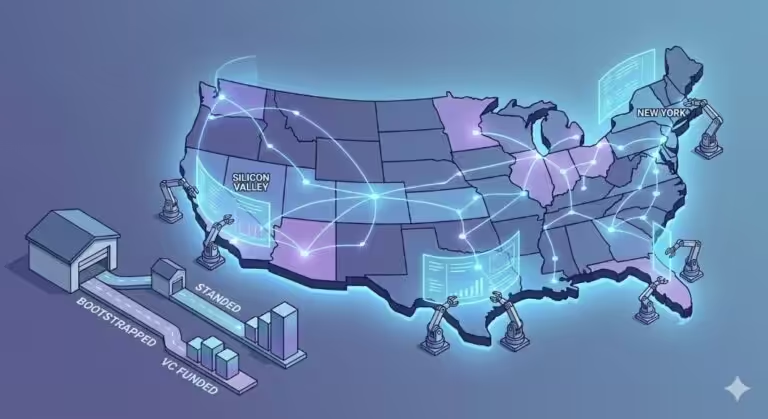
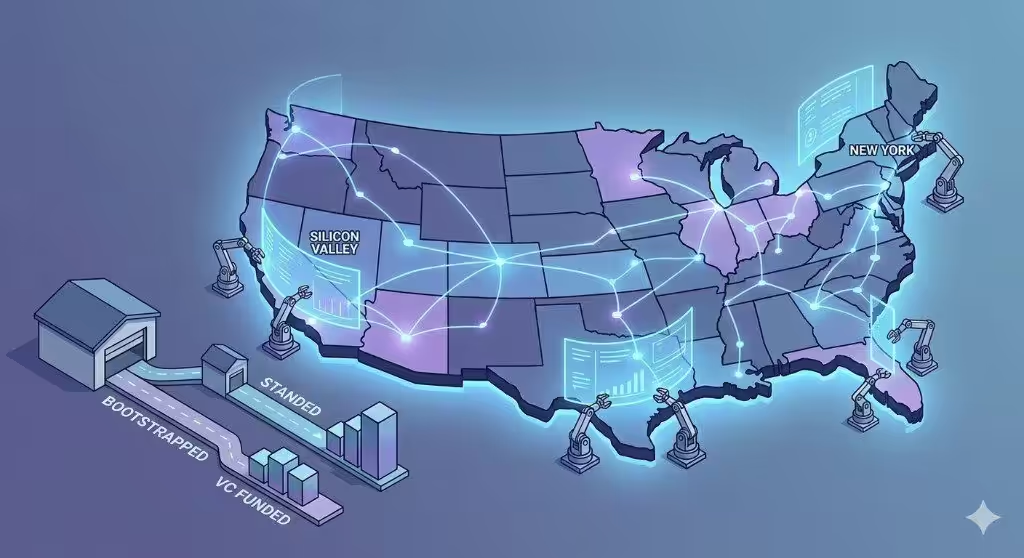
Remote work stuck where it made sense; many firms returned to hybrid hubs. Talent clusters (Bay Area, NYC, Austin, Miami, others) still concentrate capital and serendipity—just with more distributed satellites.

Regional patterns (broad strokes, not destiny)

West Coast: deep software talent, high compensation, intense competition.
Southeast growth corridors: logistics, climate-driven migration, and lower costs attract operators—not automatically “cheap forever.”
Heartland industrials: digitization of manufacturing and agriculture—slower sales cycles, durable moats when domain expertise compounds.

Comparison: startup archetypes in the US digital economy

Archetype Advantage Pressure
Vertical SaaS Deep workflows Long implementation
AI application layer Fast value if grounded Commoditization risk
Fintech Large TAM Regulatory heat
Climate tech Policy tailwinds Capex intensity

Who should care

  • Founders mapping ICP and distribution before chasing model novelty.
  • Enterprises buying outcomes, not “AI features.”
  • Policymakers balancing innovation with consumer protection—a moving target.

Pros and cons of the “always shipping” culture

Pros

  • Rapid learning loops; strong tooling ecosystems
  • Access to capital and advisors (unevenly distributed, but real)

Cons

  • Burnout and ethical shortcuts when metrics dominate
  • Hype cycles that waste budgets on demos
  • Inequality between coastal knowledge workers and other labor markets—politically and economically salient

Case-study pattern: from feature factory to outcome owner

A B2B SaaS team pivots marketing from “AI-powered” claims to documented ROI calculators tied to customer telemetry. Sales cycles shorten not because AI is absent—implementation becomes understandable. The revolution is clarity.

Capital markets and what changed after the hype reset

Venture and growth equity still fund US digital companies, but diligence tightened. Investors ask for net revenue retention, payback periods, and infrastructure costs exposed by usage-based AI APIs. Founders who treat AI spend as COGS—with budgets and alerts—navigate fundraising more credibly than those who present “infinite upside” narratives.

Bootstrapped counterpoint: many profitable digital businesses never take venture capital. Their revolution is margin and owner control; technology is still central, but cap tables stay simpler.

Labor, skills, and the missing middle

The US faces a skills mismatch: abundant entry-level applicants for some remote roles, shortages in specialized areas (security, ML ops, certain trades supporting data centers). Digital transformation sounds abstract until you try to hire three senior platform engineers in a quarter. Companies respond with upskilling, contractors, and automation—each with tradeoffs in quality and culture.

Infrastructure as a quiet enabler

Cloud regions, interconnection, and even local permitting for power-hungry facilities shape what startups can ship. The digital revolution is partly electrons and fiber, not only ideas. Founders in AI-heavy stacks increasingly model energy and latency into product design early.

Policy and trust

Antitrust, privacy, and AI governance debates are not academic—they change roadmaps. US operators increasingly maintain parallel playbooks for state privacy laws and sector rules. See our companion pieces on AI regulation and privacy patchwork.

Why trust this guide

InsightEra treats this article as independent editorial analysis, not vendor promotion. We separate observed patterns, composite examples, and opinionated recommendations so readers can judge evidence and context clearly.

Author accountability and editorial method

Author: Sarmad, Founder & Lead Author at InsightEra.
Each material update is reviewed for technical plausibility, operational usefulness, and risk transparency (privacy, security, and maintenance tradeoffs). We update guidance when facts change and keep recommendations practical for operators.

For publication-wide standards, see:
– About
– Editorial Policy
– Disclaimer

FAQs

Is Silicon Valley still dominant?
In software and venture, yes—in degree, not monopoly. Other hubs matter more than a decade ago.

Are US startups more innovative than Europe or Asia?
Comparisons are messy; the US leads in certain risk capital and software patterns while lagging in others (infrastructure, healthcare access).

What should a new founder prioritize?
Distribution truth and retention; technology choices follow.

Is the US losing its tech edge?
Edge is not monolithic. The US remains strong in software, cloud, and capital formation while facing challenges in manufacturing scale, energy permitting, and domestic talent pipelines. Honest founders plan for multi-polar supply chains.

Research commercialization: lab to market

The US excels at research universities and defense-adjacent innovation, but translation to products is uneven. Startups that win often embed domain experts early—not only engineers—and respect procurement cycles in regulated industries. The “digital revolution” in deep tech is frequently slow until standards and certifications align.

Education and talent pipelines

Coding bootcamps, online certificates, and community colleges expanded access, yet employers still report gaps in systems thinking and security. Companies investing in structured mentorship and internal universities often outperform those expecting ready-made hires—especially as toolchains churn faster than curricula can update.

A note on optimism (without naivety)

Digital tools can democratize access—to information, markets, and creative expression. They can also concentrate power in platforms and amplify misinformation when incentives misalign. Building responsibly is not Luddism; it is engineering ethics with receipts: transparent metrics, user control, and humility about unknown externalities.

Related on InsightEra

  • AI regulation and governance in the United States
  • Bootstrapped vs venture capital: 2026 reality check
  • Grocery and neighborhood retail
  • AI for online businesses
  • Future of work: hybrid realities

InsightEra publishes analysis—not investment, legal, or policy advice.

Takeaway: the US digital revolution rewards specificity: who you serve, what you measure, and how honestly you handle failure modes when scaling.

sarmad on March 24, 2026 Business & technology Innovation
previous article
Next article

Leave a comment Cancel reply

Your email address will not be published. Required fields are marked *

categories

  • AI
  • Architecture
  • Built environment
  • Business
  • Business & technology
  • Creative
  • Crypto
  • Data
  • Design & Technology
  • Digital
  • Digital art
  • Entrepreneurship
  • Future of work
  • Innovation
  • Local
  • Marketing
  • Modern Architecture
  • News
  • Operations
  • Policy & governance
  • Product
  • Productivity
  • Retail
  • Retail & business
  • Retail & technology
  • Security
  • Smart spaces
  • SMB
  • Startups
  • Sustainability
  • Technology
  • Trends
  • Web

related articles

  • Documenting Decisions for Async Teams: Memos That Replace MeetingsMarch 26, 2026
  • Marketplace Fees and Unit Economics: What Sellers Should Model Before ScalingMarch 26, 2026
  • Product Analytics and Ethics: Telemetry Your Users Can DefendMarch 26, 2026

popular tags

AI AI Tools artificial intelligence breaking news compliance Digital Transformation InsightEra operations retail SMB United States

About Us

InsightEra is a modern digital platform focused on technology, business, and innovation.
We share well-researched insights, practical guides, and trend-driven content to help
readers understand complex ideas in a clear and simple way.

Our mission is to inspire curiosity, support smart decision-making, and deliver
valuable knowledge that empowers individuals and businesses in the digital age.

Read next
Documenting Decisions for Async Teams: Memos That Replace Meetings 5 Min
Documenting Decisions for Async Teams: Memos That Replace Meetings
sarmad on March 26, 2026
Remote and hybrid teams promised focus time—and often delivered meeting sprawl across time zones. Async work...
Marketplace Fees and Unit Economics: What Sellers Should Model Before Scaling 5 Min
Marketplace Fees and Unit Economics: What Sellers Should Model Before Scaling
sarmad on March 26, 2026
Selling through large marketplaces—generalist ecommerce platforms, app stores, or vertical B2B exchanges—can unlock...

Product Analytics and Ethics: Telemetry Your Users Can Defend 5 Min
Product Analytics and Ethics: Telemetry Your Users Can Defend
sarmad on March 26, 2026
Product teams crave telemetry—clicks, funnels, errors, feature usage—to prioritize roadmaps. Users increasingly ask...

© 2025 — ontario by GT3Themes. All Rights Reserved.

Back to top