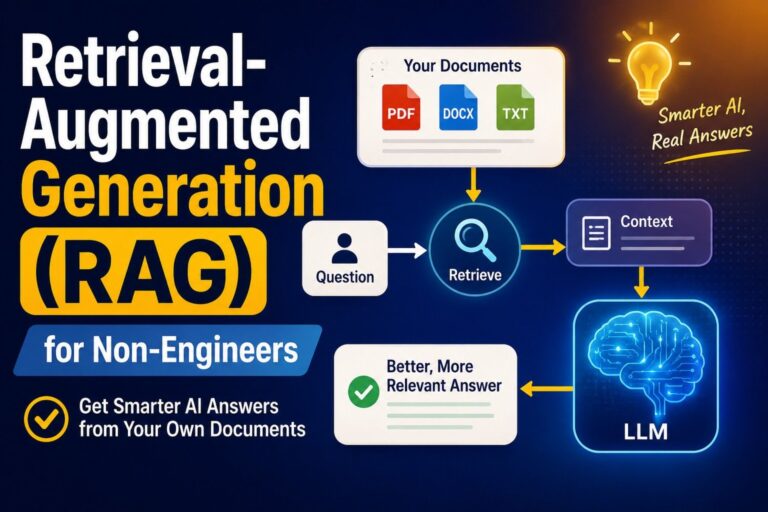
Retrieval-Augmented Generation (RAG) for Non-Engineers:
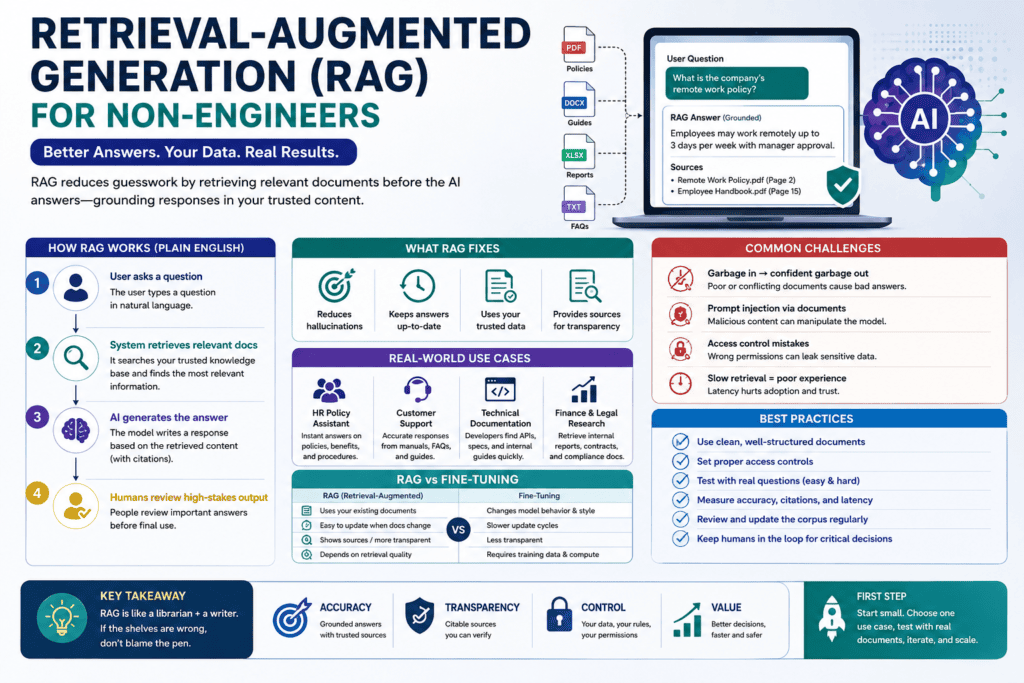
Language models make predictions based on patterns learned from training datasets. In a business setting, such prediction will not be acceptable most of the time. Retrieval-Augmented Generation (RAG) for Non-Engineers makes the job of predicting easier by retrieving relevant documents before the model makes its prediction—relying on the answers based on your PDFs, policies, and knowledge database. The explainer steers away from complex mathematics and concentrates on the output, pros, cons, and technical requirements for teams with no Ph.D. in machine learning. Retrieval-Augmented Generation (RAG) for Non-Engineers is key to better precision.
RAG combines information retrieval with the generative AI system to give more accurate answers. For an elaborate explanation, refer to the
Google Cloud guide to Retrieval-Augmented Generation.
Overview of Retrieval-Augmented Generation (RAG) for Non-EngineersRelevant to Retriever-Augmented Generation The basics of Retrieval-Augmented Generation (RAG) Understanding for Non-Engineers.
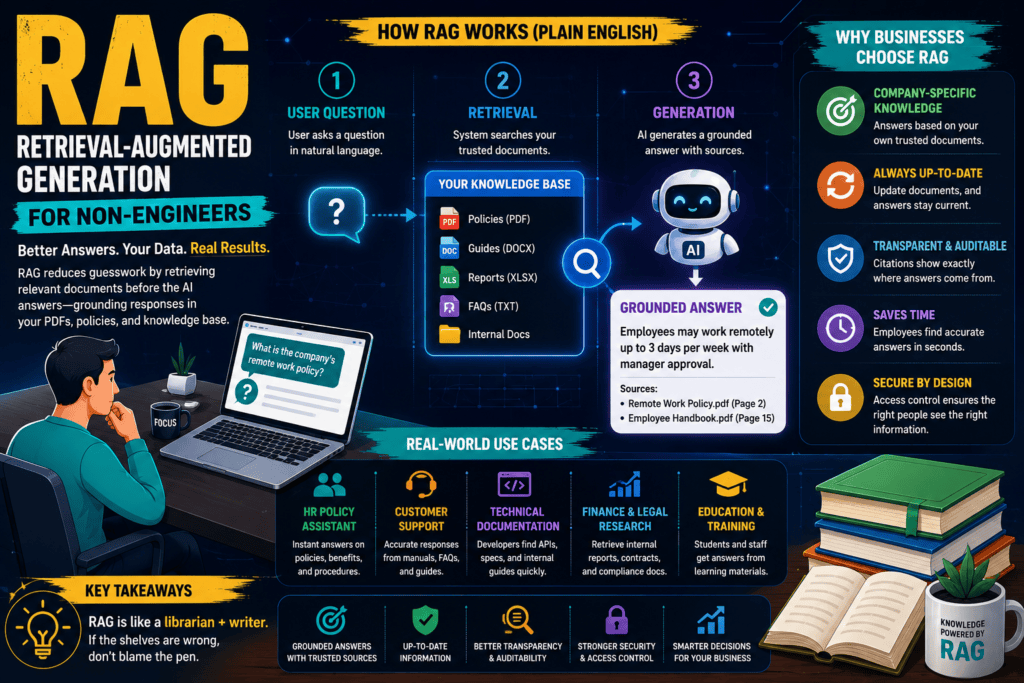
Explanation of mechanics in layman terms
Retrieval-Augmented Generation may come in handy in many practical cases in everyday business. It is not necessary to have an all-knowing AI system; in most cases, what is required is an assistant which understands the specific set of information sources and is capable of finding the needed answer.
For instance, the HR department of a company may make use of RAG and develop an internal assistant that would help in answering questions related to employees’ policies, vacations, benefits, and procedures at work. Instead of looking through multiple PDFs, the employee would just need to ask a question in the natural language form.
What RAG fixes
- Proprietary facts hallucinations
- Outdated training cutoffs—If you have updated your corpus, the responses can be up-to-date on current policies.
- Retrieval-Augmented Generation (RAG) for Non-Engineers solves these problems efficiently.
- Retrieval-Augmented Generation Businesses prefer Retrieval-Augmented Generation due to two important aspects. Traditional search engine might give a large number of documents to browse through while the employee searches for an answer. A generic AI system might provide a plausible answer not being aware of the newest data of the firm.
- Retrieval-Augmented Generation The biggest advantage is that RAG can use specific knowledge of the business. A generic AI system will be aware of the common information of the matter but won’t necessarily know the specific company procedures, documentation, pricing rules, etc.
- Nevertheless, one should treat RAG as not a magical solution giving accurate results all the time. There is still a need for governance, testing, permissions, and human oversight.
What RAG breaks if you are sloppy
- When documents conflict, inputting garbage leads to confident outputting of garbage
- Injection of prompts through malicious documents
- Latency impact when retrieval takes time
- Common RAG Mistakes to Watch Out For
- Creating a RAG solution involves more than just connecting documents to the AI model. There are several mistakes that can make it less effective.
- Using old documents
- Total reliance on AI
- RAG should assist human decision making and not replace it, especially when risks are involved. Employees need to understand when the answer needs to be verified by a competent person.
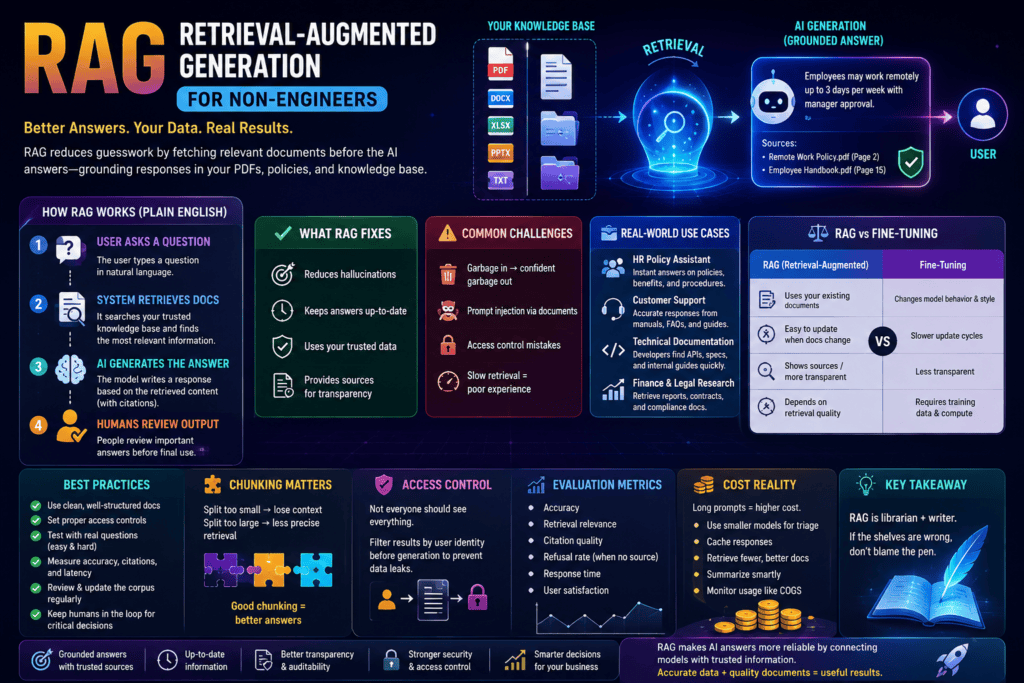
Comparison: RAG vs Fine-tuning
| Approach | Strength | Weakness |
|---|---|---|
| Retrieval-Augmented Generation (RAG) for Non-Engineers | Fresh knowledge | Retrieval quality dependency |
| Fine-tuning | Style/behavior | Slower update cycles |
Who should use what
- Policies and manuals → Retrieval-Augmented Generation (RAG) for Non-Engineers first
- Brand voice → fine-tune or style guides + RAG
- Situation When RAG Will Be Superior to Other Methods
- It is common that RAG works well when information is constantly changing. Policies in companies, technical documents, prices, and all other information can be changed frequently.
- Suppose there is a company that updates an employee handbook every few months. In the case of a retrieval-based approach, the company will need to check whether the assistant retrieves a new version of the document.
Pros and cons
Pros
Answers backed up with references
Auditable sources
Cons
Corpus maintenance and access control
Engineering effort (and not just a checkbox task)
How to Measure RAG Performance
The evaluation of a RAG system must be carried out using real questions before releasing the system to many users. Demonstrating the effectiveness of the system is not enough to show that the system is effective.
Another metric that can be used is that of retrieval quality. The language model might be able to provide an answer but might retrieve wrong documents.
Organizations can conduct these tests whenever there are changes in the documents, retrieval configuration, and the models used.
Cost reality: tokens add up
Grounded responses can be lengthy; long queries take more money. Summary techniques, caching, and smaller models can be employed for triage. Inference is treated as COGS.
Controlling Costs of RAG
Systems using RAG can incur high costs when they pull too much data or pass too much text data to the language model.
Cost control must be a routine practice. The team needs to monitor usage, length of responses, model used, and infrastructure costs.
A Simple RAG Implementation Roadmap
Several pragmatic steps may be considered when working on RAG.
Step 1: Define the use case
Focus on a single business case. An internal knowledge assistant for employees will be easier to evaluate compared to the company-wide chatbot.
Step 2: Gather trusted documents
Find all policy documents, manuals, guidelines, FAQs, etc. that should be used by the system. Delete duplicates and obsolete documents.
Step 3: Process the collected data
Documents have to be transformed into a machine-searchable format. Take into account tables, headings, metadata, versions of the documents.
Step 4: Implement the retrieval and generation modules
Relevant information is searched by the retrieval module; the language model uses retrieved information to compose the answer.
Step 5: Evaluate the prototype using realistic questions
Apply a consistent set of test questions to evaluate the accuracy, retrieval quality, citation, latency, and refusal behavior of the prototype.
Step 6: Deploy the prototype in the limited pilot version
Deploy the system to a limited number of users. Analyze the received feedback and failure cases before a large-scale implementation.
Step 7: Continuous monitoring and improvements after launch
Continuously monitor the freshness of the documents, the access permissions, the retrieval quality, the feedback from the users, and
Table of Contents
FAQs
Do we need a vector database?
Often yes—but design matters more than buzzwords.
Is RAG “safe AI”?
Safer than raw generation—not safe without governance.
Related on InsightEra
- AI regulation and governance
- AI for online businesses
- When AI-first is a mistake
- US data privacy patchwork
- Minimalist robots
Takeaway: Retrieval-Augmented Generation (RAG) for Non-Engineers is librarian + writer—if the shelves are wrong, do not blame the pen.