

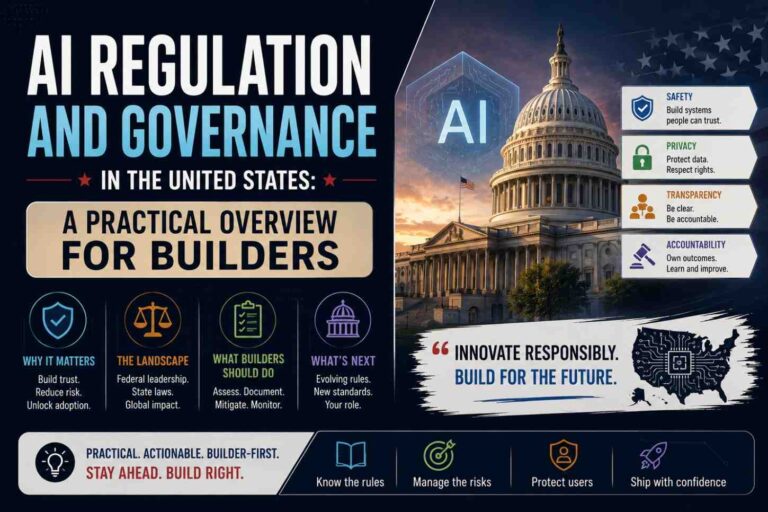
APractical Overview for Builders
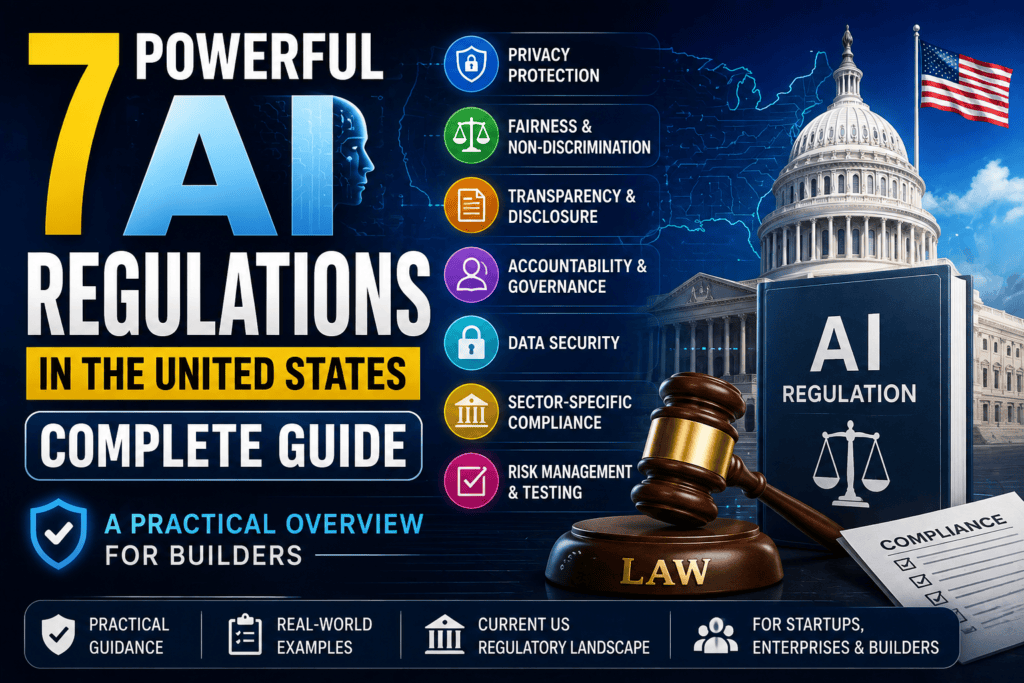
7 Powerful AI Regulations in the United States: Complete Guide
Regulation follows attention. As AI technologies implicate hiring, lending, healthcare, education, and other services, US policymakers grapple with risk classification, transparency, and liability frameworks—with no ultimate consensus and federal uniformity. For builders and operators, the relevant question is not “What will Congress pass?” but “What legal obligations apply to my product, data type, and users—and how do I demonstrate compliance?” This overview outlines existing pressures, themes, and governance steps—while making no attempt to serve as substitute for advice.
What already binds you (conceptual map)
7 Powerful AI Regulations in the United States:
Privacy: sectoral regulations (HIPAA, GLBA, COPPA) and state-level privacy acts (California and others) related to disclosures, opt-outs, and vendor agreements.
Consumer protection: ban on unfair or deceptive practices from the FTC Act, which also applies to AI marketing.
Civil rights: areas covered by the EEOC guidance on employment tools; considerations from HUD/FHA in housing contexts.
Financial services: model risk management expectations from regulators concerning institutions that you serve as vendors.
The list is by no means complete, which explains why “we’re just a wrapper” is often an illusion.
7 Powerful AI Regulations in the
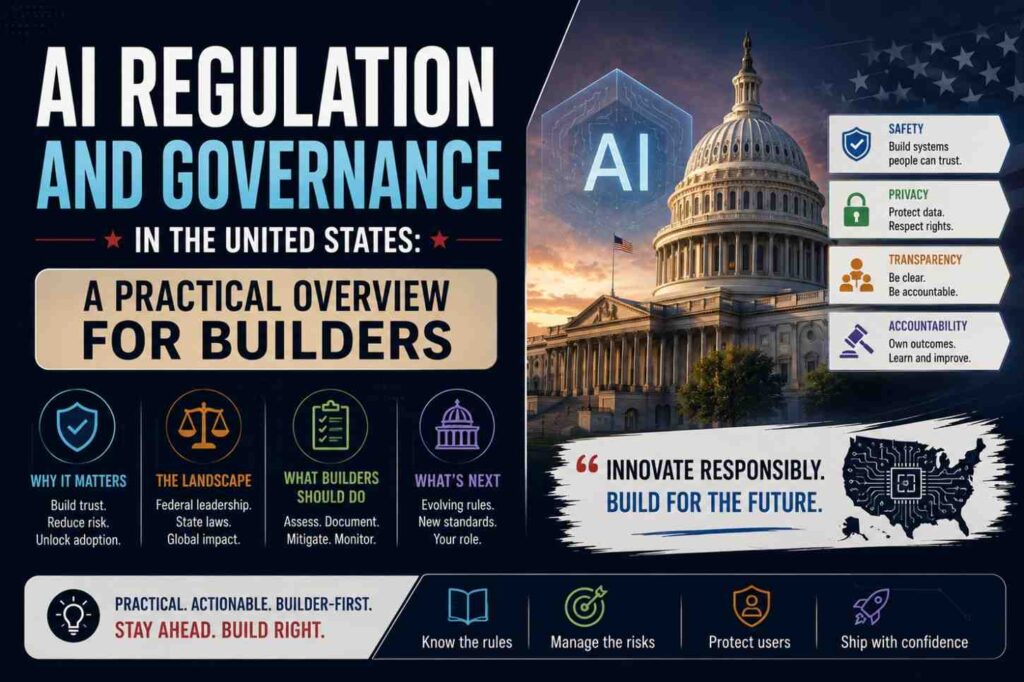
States’ privacy laws and regulations related to AI: why your “US-only” app still causes legal problems
7 Powerful AI Regulations in the United States: Complete Guide Not having a comprehensive privacy law, California, Colorado, Virginia, and some other states adopted notice, opt-out and processor obligations that penetrate into SaaS. If you process personal data in the broad sense, privacy compliance will not be just a way of “future-proofing” – it is mandatory to participate in the mid-market.
Operationally, what this means: keep the record of the processing activities, identify subprocessors and provide clear privacy notices. It will be asked by your buyer; it will be asked by your insurer.
7 Powerful AI Regulations in the United States Data mapping is among the most concrete measures that an AI developer can undertake before the product launch. You need to know from which sources personal data are introduced, where it is stored, which models process it and which vendors have access to it.
Enforcement practice: agencies and private plaintiffs
7 Powerful AI Regulations in the United States While regulators move slowly but when they decide to act, they are very resolute. Class actions against biometric data and tracking technologies show that technical
New emerging themes (federal watchlist)
7 Powerful AI Regulations in the United States: Complete Guide Debates on AI regulations may cover testing and evaluation of high-risk systems, watermarking for synthetic media, and national security export control over hardware and weights.
7 Powerful AI Regulations in the United States AI regulations are evolving along with the technology itself. New models, applications, and business processes may bring certain risks that the existing rules have not been written about explicitly. This is why it is essential for builders not to treat compliance with the law as a project that ends once it is completed. One particular policy that seems appropriate now may require a revision after a significant update of a product, introduction of a new customer group, or even a change of the model.
How Builders Can Prepare for Regulatory Changes
AI regulations in the United States continue to evolve, so businesses should not build their compliance programs around one particular proposal. They will be better off if they develop flexible governance processes that will enable them to adjust to the changing requirements.
The first step here will be to record what every AI feature does, what information it works with, what
7 Powerful AI Regulations in the United States You do not need a large compliance team to start building an AI governance process.
Final Note for Builders
AI regulation should be treated as an ongoing responsibility rather than a one-time compliance task. As products, models, data sources, and customer requirements change, teams should regularly review their controls, documentation, testing, and user disclosures to keep AI systems trustworthy and accountable.
New Emerging Themes (Federal Watchlist)
7 Powerful AI Regulations in the United States: Complete Guide Debates regarding AI regulations can include testing and evaluation of high-risk systems, watermarking of synthetic media, and national security export control of hardware and weights.
7 Powerful AI Regulations in the United States With AI regulations developing together with AI itself, new models, applications, and business processes can create some risks that have not been covered by the existing regulations. This is why compliance with the law is an ongoing process that needs to be taken into consideration during the entire period of work. A policy which seemed appropriate at first can require further revision due to updating the product, targeting a new customer segment, and so on.
How Builders Can Prepare for Regulatory Changes
AI regulations in the United States are still developing, which means that companies need to prepare for changes. They shouldn’t base their compliance programs on one particular proposal, as flexibility will help them to adapt to new regulations more easily.
Firstly, it is important to record the functions of every AI feature, the type of information it uses, what
Pros and cons of proactive governance
Pros
- More efficient enterprise sales when security assessments proceed well
- Less damage to reputation when incidents happen
- Improved clarity internally, not so many hasty fixes
Cons
- Cost and delay in early product development phases
- Ambiguity in standards results in overbuilding
- Overlap in jurisdiction causes confusion
- What must builders keep documentation for?
- 7 Powerful AI Regulations in the United States Documentation is particularly critical since AI products evolve very rapidly. Keep track of the decisions made, instead of relying solely on informal discussions.
7 Powerful AI Regulations in the United States: Complete Guide
- Inventory AI features and data flows; tag risk levels.
- Write an internal policy: acceptable use, retention, review requirements.
- Test models on representative data; log evaluations over time.
- Contract vendors with clear subprocessor and incident terms.
- Train customer-facing teams on escalation when outputs go wrong.
Rationale for this guide
7 Powerful AI Regulations in the United States InsightEra views this article as independent editorial commentary. We disentangle patterns noticed, composite examples created, and subjective recommendations made to allow readers to consider the underlying evidence and its context.
7 Powerful AI Regulations in the United States Human review can serve as an effective control mechanism whenever the output from AI has material impact on people. The teams have to establish criteria for when the human review of AI recommendation has to take place, when the output can be accepted automatically, and when issues need escalation.
About the author and editorial process
Author: Sarmad, Founder & Lead Author at InsightEra.
Every material update is verified for plausibility, utility, and risk transparency (privacy, security, and maintenance considerations). We make changes to our guidance based on new facts, and keep our recommendations actionable for operators.
See our publication-wide policies for:
- About
- Editorial Policy
- Disclaimer
7 Powerful AI Regulations in the United States Ask several practical questions prior to deploying an AI component. What is the purpose of the system? What type of input do you need? Will the output impact the individual’s employment, finances, health care,
Related on InsightEra
- US data privacy patchwork: what operators actually do
- RAG for non-engineers
- When AI-first is a mistake
- AI for online businesses
- The digital revolution in the USA
InsightEra publishes educational content—not legal advice. Consult qualified counsel for your situation. - Takeaway: treat AI governance as product discipline: measurable tests, documented decisions, and honest user-facing limits.
Table of Contents

View comments (1)