
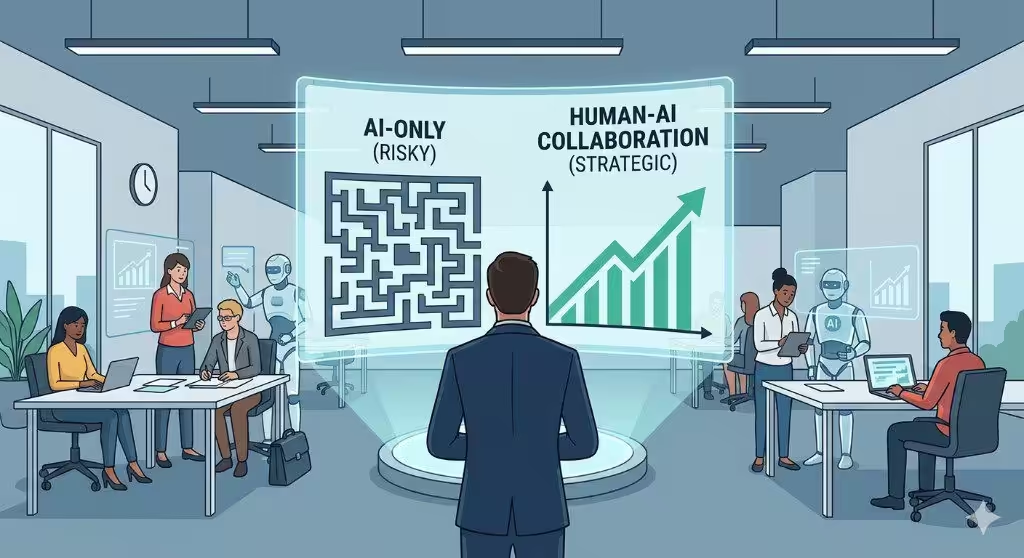
Complexity is easy to demo; restraint is hard to ship. In robotics and adjacent hardware, a “minimalist” approach does not mean cheap aesthetics—it means fewer degrees of freedom, fewer failure modes, and fewer integration surfaces that can break in production. Teams that win often build machines that look boring on a spec sheet but reliably perform a narrow job. This article unpacks why minimal robot designs accelerate learning cycles, where they fail, and how to map minimalism to real business outcomes—not Instagram-friendly renderings.
What “minimalist robot” should mean in engineering terms
Minimalism is not a styling choice alone. In product development, it maps to:
- Task scope: one well-defined motion or manipulation pattern instead of “general purpose.”
- Sensing budget: the minimum sensor set that still closes the control loop safely.
- Compute budget: edge controllers that do not need data-center budgets for inference.
- Serviceability: fewer bespoke parts, clearer replacement paths.
A minimalist robot might be a cartesian pick-and-place with a vacuum cup, not a humanoid that waves. The innovation is in throughput per dollar and mean time between failures, not joint count.
Real examples (patterns we see repeatedly)
Prototype-to-pilot in small factories: A contract manufacturer replaces ad-hoc human transfer between two CNC cells with a single-axis shuttle and interlocks. No vision stack at first—just mechanical stops and torque limits. Uptime improves; later, they add a camera only when the mechanical baseline is stable. Minimal first; smart second.
Laboratory automation: Liquid-handling startups often converge on deck layouts with fewer moving gantries and more clever consumable design. The robot is not the hero; the workflow is.
Consumer-adjacent devices: Robotic vacuums succeeded partly because the task environment (flat floors, clutter tolerance) matched a simple behavior stack. Compare that with open-ended “kitchen assistant” concepts that stall: the environment is chaotic; minimalism without environmental control does not help.
Comparison: minimal vs. maximal robot ambition
| Dimension | Minimalist platform | Maximalist platform |
|---|---|---|
| Time to first useful hour | Weeks–months | Often quarters+ |
| Integration risk | Lower | Higher |
| Talent requirements | Mech + controls generalists | Specialists across ML, vision, safety |
| Storytelling | Harder for fundraising decks | Easier in hype cycles |
| Long-term moat | Operations + reliability | IP + data (if real) |
Who should use what
- Startups validating demand should bias minimal: prove repeatable task economics before expanding scope.
- Incumbents with service networks can sometimes afford complexity because they amortize field service across fleets.
- Research labs legitimately need maximal platforms—but R&D is not the same as product.
Pros and cons
Pros
- Faster iteration: fewer subsystems to debug simultaneously.
- Clearer safety cases for narrow environments.
- Easier cost-down paths when volumes arrive.
Cons
- Narrowness can cap upside if the market wants flexibility.
- Perception: investors may mistake minimal for “unserious.”
- Edge cases still exist; minimal does not mean zero risk.
Procurement reality: why minimal robots survive purchasing
Enterprise buyers increasingly score vendors on total cost of ownership: spare parts lead times, training burden, and whether a junior technician can swap a module during third shift. Minimal platforms often win here because the bill of materials is legible. A complex arm with custom reducers and proprietary buses can outperform in a demo—and then sit idle while awaiting a specialist from another time zone.
Real pattern: a logistics pilot chooses a two-axis gantry with commodity PLCs because the facility already stocks compatible components. The “less capable” robot ships more pallets per month than a flashy alternative waiting on firmware patches.
Safety and minimalism: not the same as “less safe”
Minimal degrees of freedom can simplify risk assessment—clearly defined reach envelopes, fewer unexpected configurations. But minimalism is not a substitute for guarding, interlocks, and lockout/tagout training. Some teams mistakenly assume a small robot cannot hurt anyone; pinch points and collisions still exist. Treat every deployment with site-specific analysis.
Minimalism and innovation culture
Organizations confuse innovation with novelty. Minimal robots force teams to articulate constraints honestly: what must never happen (crush hazard, mis-pick), what can fail softly (reject station), and what humans still must supervise. That discipline often improves software quality across the stack, not only hardware.
Conversely, teams addicted to novelty ship science fair milestones: demos that require babysitting. Minimalism is an antidote because it ties pride to operational minutes, not GIFs.
Why trust this guide
InsightEra treats this article as independent editorial analysis, not vendor promotion. We separate observed patterns, composite examples, and opinionated recommendations so readers can judge evidence and context clearly.
Author accountability and editorial method
Author: Sarmad, Founder & Lead Author at InsightEra.
Each material update is reviewed for technical plausibility, operational usefulness, and risk transparency (privacy, security, and maintenance tradeoffs). We update guidance when facts change and keep recommendations practical for operators.
For publication-wide standards, see:
– About
– Editorial Policy
– Disclaimer
FAQs
Are minimalist robots always low-tech?
No. They may include advanced materials or precision gearing. “Minimal” refers to system complexity relative to task, not component sophistication.
Does AI make minimalism obsolete?
Often the opposite: good ML can reduce sensing needs when data is clean. In messy open worlds, ML increases brittleness unless paired with mechanical guardrails.
When should we add sensors?
When measured error rates justify the integration cost—and not before the mechanical baseline is understood.
How do we measure success in a pilot?
Track OEE contributors (downtime reasons), scrap attributable to handling, and operator interventions per hour. If those do not move, the robot is theater.
Metrics that separate pilots from production
Teams serious about hardware treat dashboards like product managers treat funnels:
- Mean time to recovery (MTTR) after faults—can night shift restore service without calling engineering?
- Repeatability drift—do picks degrade as tooling wears, temperature swings, or belt tension changes?
- Spare consumption—are you burning through consumables because the motion profile is aggressive?
Minimalist machines often shine on these boring graphs. That is the point.
Related on InsightEra
- Robotics in logistics: where hype ends on the loading dock
- Modular devices and modern workflows
- The digital revolution in the USA
- Retrieval-augmented generation for non-engineers
- AI for online businesses
InsightEra publishes independent analysis. Robotics deployments involve safety, labor law, and site-specific risk—consult qualified professionals.
Takeaway: ship the smallest reliable machine that earns minutes in the real world. Expand capability when data and dollars say so—not when the slide deck does.