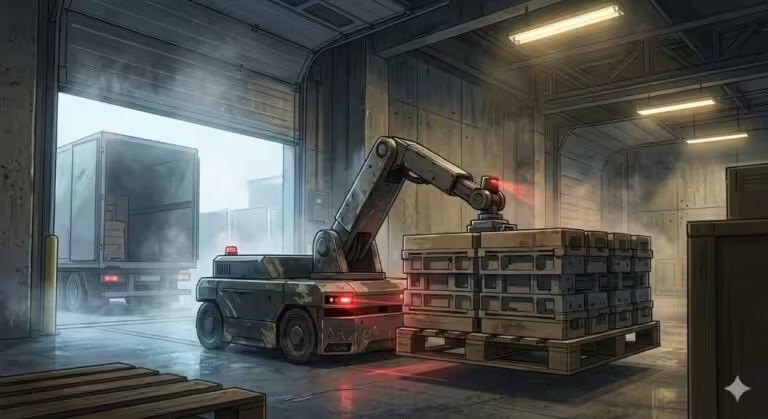
Logistics robotics headlines focus on humanoid prototypes and lights-out warehouses. Operational reality is messier: mixed SKU pallets, damaged labels, weather, labor agreements, and legacy WMS systems that do not like change. This article grounds the discussion in dock-level constraints—where capital decisions win or lose—and compares automation strategies by facility type.
What actually gets automated first
- Repetitive pallet movements with clean handoffs
- Sortation in high-volume hubs with standardized induction
- AS/RS where SKU predictability supports storage algorithms
Real example: retrofit pain
A regional 3PL attempts robotic picking without fixing inventory accuracy. Robots idle while humans reconcile exceptions—throughput flat, capital spent. The honest prerequisite was data hygiene.
Comparison: AMR vs fixed automation
| Approach | Flexibility | Capital intensity |
|---|---|---|
| AMRs | Higher | Medium |
| Fixed conveyance | Lower | High upfront |
Who should use what
- Volatile SKU mixes → favor flexible AMRs with strong fleet software.
- Stable high-volume lines → fixed systems can win on speed.
Pros and cons
Pros
- Labor relief in tight markets
- Ergonomic improvements when done well
Cons
- Integration debt
- Maintenance skills gap
Labor, unions, and change management
Automation proposals fail when floor staff discover plans from vendors before internal communication lands. Successful rollouts include early dialogue, retraining budgets, and realistic timelines. Robotics is not only capital expenditure—it is organizational change.
Maintenance and spares strategy
Robots consume parts: wheels, belts, sensors. If your facility cannot store spares or wait weeks for overseas shipments, uptime collapses. Negotiate SLAs and train in-house techs for tier-one fixes.
Software: WMS integration reality
The prettiest robot fails if the warehouse management system lacks accurate inventory locations. Integration projects often cost more than hardware. Budget time for data cleanup and exception workflows.
Safety and standards
Forklifts and humans still share space. Risk assessments, light curtains, and speed limits matter. Skipping safety to accelerate pilots invites liability and moral failure.
Pilot design that leadership can trust
The best pilots pick one facility zone, one throughput metric, one safety metric, and one labor-impact metric before launch. If baseline and success criteria are unclear, results become storytelling instead of operations. Publish the pilot scorecard weekly to operations and finance, including downtime causes and exception rates, so expansion decisions are based on evidence rather than vendor demos.
Total cost of ownership beyond hardware price
Automation business cases often undercount integration work, retraining, downtime during cutover, and spare-part logistics. A realistic TCO model should include implementation labor, software subscriptions, maintenance contracts, and expected productivity dips during ramp-up. Without this, ROI projections look impressive in slide decks and disappoint in operations reviews.
Finance teams trust projects more when assumptions are explicit and periodically re-baselined after pilot data arrives.
Exception handling defines real throughput
In live facilities, most pain sits in exceptions: damaged labels, odd-sized pallets, blocked lanes, and inventory mismatches. The automation winner is not the system with the best demo speed; it is the system with the best exception playbook and recovery time.
Document escalation rules before launch. Who pauses the system? Who overrides safely? Who logs root cause? Facilities that answer these questions early avoid costly finger-pointing after go-live.
Readiness checklist before scaling robots
Verify inventory accuracy, exception ownership, spare-part lead times, and supervisor training before expanding to a second zone. Scaling without these controls multiplies downtime and undermines trust in the program.
Workforce upskilling plan
Automation programs that invest in supervisor and technician training usually outperform those that rely only on vendor support. A practical upskilling plan includes safety drills, exception handling, and basic diagnostics. People readiness is part of system readiness.
Practical implementation note
To keep this actionable, run a 30-day execution cycle with one owner, one success metric, and one weekly review checkpoint. If outcomes are improving, scale carefully; if not, document failure causes before changing tools. This prevents strategy drift and turns content ideas into measurable operating decisions.
Procurement guardrails
Before signing, require acceptance tests tied to your real workflow, not showroom scenarios. Include change-order limits, response SLAs, and integration accountability in writing. Procurement discipline is often the difference between a successful automation rollout and a costly pilot that never reaches stable production.
Facility sequencing
Scale in stages: stable pilot cell, then adjacent zone, then multi-shift expansion. Each stage should pass safety and uptime thresholds before the next budget release.
Post-pilot go/no-go gate
Before expansion, leadership should sign off on a simple go/no-go gate: safety incidents stable, uptime target met, and labor process documented for all shifts. This formal gate prevents politically driven scaling before operations are ready.
FAQs
Are humanoids ready?
Most value today is narrow robots with clear tasks.
What ROI timeline is realistic?
Often 18–36 months fully loaded—shorter only when prerequisites were already strong.
Related on InsightEra
- Minimalist robots and innovation
- Modular devices and modern workflows
- Future of work: hybrid realities
- The digital revolution in the USA
- AI for online businesses
Takeaway: automate truth in inventory before automating motion.