
• Home
  • Contact
  • Privacy Policy
  • Cookies
  • About
  • Terms
  • Disclaimer
  • Editorial Policy
HomeBusiness_technology From Side Project to Revenue: A Timeline You Can Actually Steal (and Adapt)

From Side Project to Revenue: A Timeline You Can Actually Steal (and Adapt)

sarmad on March 24, 2026
Business_technology Startups
6 Min Read

From Side Project to Revenue: A Timeline Actually Steal
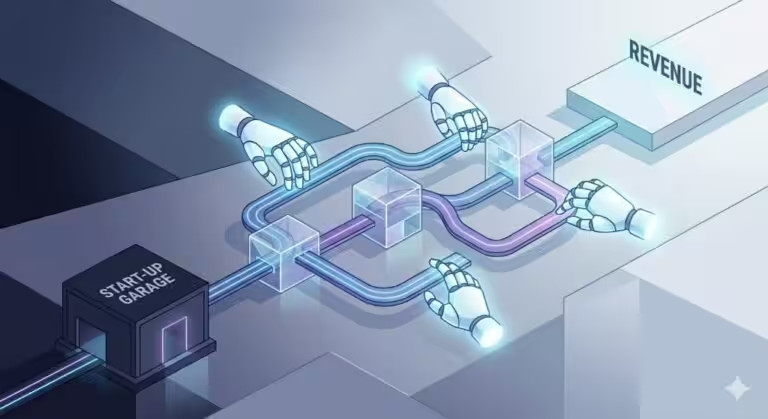
Side projects die from ambiguity: unclear ICP, unclear pricing, unclear weekly hours. This article proposes a timeline template—not universal truth—for turning a nights-and-weekends build into paid usage. It emphasizes constraints, milestones, and honest kill criteria. Adjust durations to your life; keep the sequence.

Phase 0: problem lock (2–4 weeks)

Write a one-page problem hypothesis with evidence: interviews, forum pain, invoices you’ve seen. If you cannot name who pays, you do not have a business—only a project.

Phase 1: concierge MVP (4–8 weeks)

Deliver value manually where possible. A human behind the curtain teaches you edge cases before code hardens them.

Phase 2: paid pilot (4–12 weeks)

Offer a narrow pilot to three customers max. Price to value, not your hours—document outcomes.

Phase 3: productize (8–16 weeks)

Automate the repetitive core; keep human review where stakes are high.

Comparison: hobby vs structured side business

Mode Outcome
Hobby Joy, learning
Structured Revenue risk

Who should use what

  • Burnout-prone founders → keep hobbies unmonetized intentionally.
  • Career accelerators → structured path with time boxing.

Pros and cons

Pros

  • Revenue validates willingness-to-pay
  • Forces prioritization

Cons

  • Less pure creativity
  • Support obligations

Time boxing and family reality

Side projects fail when founders steal sleep instead of stealing calendar. A sustainable cadence might be six focused hours weekly with phone-off deep work—not nightly chaos. If your life cannot afford even that, the timeline lengthens; honesty prevents burnout.

Pricing experiments that teach

Early revenue is a sensor: try annual vs monthly for B2B, or packaged services vs hourly. Record who buys and why. Avoid changing prices weekly; stability helps early customers refer others.

Kill criteria (save your years)

Define stop rules: if no paying customer by date X, pivot or pause. Emotional attachment to code is expensive. Document learnings even when you stop—closure has value.

Legal and ops basics (don’t romanticize)

Even small paid pilots may need basic business registration, tax awareness, and contracts that clarify IP and liability. This is not excitement—adulting reduces existential risk.

Customer discovery without building forever

Talk to ten plausible buyers before you polish UI. Ask what they paid for recently, what failed them, and what they would fire your hypothetical product to obtain. Painful truths early save years.

Distribution: the overlooked multiplier

Building is easier than distribution. Budget time for outbound, partnerships, and communities where your ICP actually gathers. If your side project relies on “SEO later,” write the distribution plan now.

Cash discipline between milestones

Revenue milestones should be paired with cost ceilings. Early founders often celebrate first dollars while quietly adding tools, contractors, and ad spend that erase gross margin. A practical rule is to lock one cost category at a time, then validate payback before expanding spend. This keeps learning velocity high without converting a side project into a fragile mini-startup with enterprise burn habits.

Customer interviews that produce pricing signal

Not all interviews are equal. Ask buyers what they currently pay, what alternatives they use, and what switching friction they fear. Questions like “would you use this” generate politeness, not signal. Questions tied to real budget behavior generate market truth.

Capture interview notes in a structured template so patterns emerge across conversations. The goal is not perfect certainty; it is reducing guesswork before writing months of code.

Retention before growth

First revenue is exciting, but repeat revenue is the real milestone. Before scaling acquisition, ensure early customers stay because the product solves a recurring problem. If churn is high, growth just accelerates disappointment.

A simple retention check is whether customers continue paying without heavy founder intervention. If renewals require constant rescue, you likely have a service business disguised as a product and should decide intentionally whether that is acceptable.

Weekly founder scorecard

Track three numbers weekly: conversations with target buyers, new revenue, and churn or retention signal. If one number is flat for too long, focus there before adding features. This keeps momentum tied to reality rather than backlog comfort.

Practical implementation note

To keep this actionable, run a 30-day execution cycle with one owner, one success metric, and one weekly review checkpoint. If outcomes are improving, scale carefully; if not, document failure causes before changing tools. This prevents strategy drift and turns content ideas into measurable operating decisions.

Decision memo habit

Keep a short weekly decision memo: what changed, what was tested, what was learned, and what is next. This creates operating memory and prevents repeating failed experiments after stressful weeks. Founders who document decisions usually move faster with less chaos because they can see pattern-level progress, not only task-level activity.

FAQs

How many hours weekly?
Sustainable beats heroic—schedule blocks.

Should I quit my job?
Only when revenue and runway math are explicit—not when a side project feels exciting.

Related on InsightEra

  • Bootstrapped vs VC
  • AI for online businesses
  • Grocery and neighborhood retail
  • Case study: 12-person agency
  • The digital revolution in the USA

Takeaway: revenue is a decision, not a side effect.

Many entrepreneurs have embraced ‘From Side Project to Revenue: A Timeline Actually Steal’ to achieve their goals.

By following ‘From Side Project to Revenue: A Timeline Actually Steal’, you can avoid common pitfalls.

Ultimately, ‘From Side Project to Revenue: A Timeline Actually Steal’ provides a roadmap for aspiring founders.

Many have found success by applying ‘From Side Project to Revenue: A Timeline Actually Steal’ in their strategies.

The insights from ‘From Side Project to Revenue: A Timeline Actually Steal’ encourage action.

Understanding the phases in ‘From Side Project to Revenue: A Timeline Actually Steal’ is crucial for growth.

Following the path outlined in ‘From Side Project to Revenue: A Timeline Actually Steal’ can yield significant results.

The approach found in ‘From Side Project to Revenue: A Timeline Actually Steal’ can transform your venture.

‘From Side Project to Revenue: A Timeline Actually Steal’ emphasizes the importance of clear objectives.

Utilizing the insights from ‘From Side Project to Revenue: A Timeline Actually Steal’, we can navigate through uncertainties.

In this journey, ‘From Side Project to Revenue: A Timeline Actually Steal’ serves as a guiding principle for many entrepreneurs.

From Side Project to Revenue: A Timeline Actually Steal

sarmad on March 24, 2026 Business_technology Startups
previous article
Next article

Leave a comment Cancel reply

Your email address will not be published. Required fields are marked *

categories

  • AI
  • Architecture
  • Built environment
  • Business
  • Business_technology
  • Creative
  • Crypto
  • Data
  • Design & Technology
  • Digital
  • Digital art
  • Entrepreneurship
  • Future of work
  • Innovation
  • Local
  • Marketing
  • Modern Architecture
  • News
  • Operations
  • Policy & governance
  • Product
  • Productivity
  • Retail
  • Retail & business
  • Retail & technology
  • Security
  • Smart spaces
  • SMB
  • Startups
  • Sustainability
  • Technology
  • Trends
  • Web

related articles

  • Documenting Decisions for Async Teams
    Documenting Decisions for Async Teams: Memos That Replace MeetingsMarch 26, 2026
  • Marketplace Fees and Unit Economics: What Sellers Should Model Before ScalingMarch 26, 2026
  • Product Analytics and Ethics: Telemetry Your Users Can DefendMarch 26, 2026

popular tags

AI AI Tools artificial intelligence breaking news compliance Digital Transformation InsightEra operations retail SMB United States

About Us

InsightEra is a modern digital platform focused on technology, business, and innovation.
We share well-researched insights, practical guides, and trend-driven content to help
readers understand complex ideas in a clear and simple way.

Our mission is to inspire curiosity, support smart decision-making, and deliver
valuable knowledge that empowers individuals and businesses in the digital age.

Read next
Documenting Decisions for Async Teams: Memos That Replace Meetings 5 Min
Documenting Decisions for Async Teams: Memos That Replace Meetings
sarmad on March 26, 2026
Documenting Decisions for Async Teams Remote and hybrid teams promised focus time—and often delivered meeting sprawl...
Marketplace Fees and Unit Economics: What Sellers Should Model Before Scaling 4 Min
Marketplace Fees and Unit Economics: What Sellers Should Model Before Scaling
sarmad on March 26, 2026
Understanding Marketplace Fees and Unit Economics for Profitability Selling through large...

Product Analytics and Ethics: Telemetry Your Users Can Defend 5 Min
Product Analytics and Ethics: Telemetry Your Users Can Defend
sarmad on March 26, 2026
Product teams crave telemetry—clicks, funnels, errors, feature usage—to prioritize roadmaps. Users increasingly ask...

Welcome to InsightEra, a modern blogging platform dedicated to delivering valuable insights, fresh perspectives, and well-researched content for curious minds. At InsightEra, we believe that knowledge is most powerful when it is clear, practical, and easy to understand.

  • Home
  • Privacy Policy
  • About
  • Editorial Policy
  • Disclaimer
  • Terms of Use
  • Cookie Policy
  • Contact

how to find us

4039 NW 70th Avenue
Coral Springs, FL 33065
United States

info@insightera.co

+1 (516) 254-8696


© 2026 — Insightera. All Rights Reserved.

Back to top