
InsightEra
  • Home
  • Privacy Policy
  • About
  • Editorial Policy
  • Disclaimer
  • Terms of Use
  • Cookie Policy
  • Contact
HomeLocal Local Retail Digital Branding: A Florida Operator’s Lens (Case-Style)

Local Retail Digital Branding: A Florida Operator’s Lens (Case-Style)

sarmad on March 24, 2026
Local Retail & business
5 Min Read

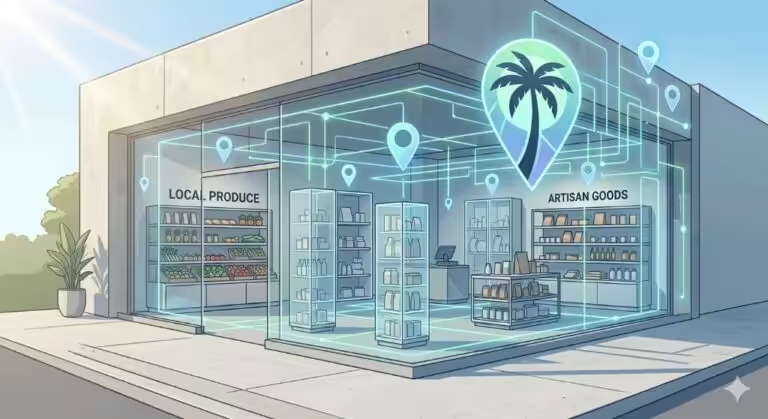
Florida’s retail corridors blend tourism, seasonal population swings, and local loyalty in ways that challenge generic playbooks. This case-style article follows a composite independent retailer—think specialty foods or home goods—modernizing its digital presence without abandoning neighborhood identity. Names are illustrative; lessons generalize beyond the Sunshine State.

Context

Bay Haven Market (pseudonym) sits near a commuter suburb with weekend tourist spillover. Online, they competed with national brands’ ad spend. Offline, they win on curation and staff knowledge. The goal: make digital reflect those strengths—not mimic big-box aesthetics.

Diagnosis

Their site looked fine but hid differentiation: hours were buried, specialty programs (feasts, classes) were absent from structured data, and photography did not match in-store warmth. SEO traffic brought curiosity, not intent.

Interventions

  • Structured local pages for services and events with schema markup.
  • Email rhythm tied to inventory reality—no vaporware promotions.
  • Short-form video shot on phones—authenticity beats glossy stock.
  • Google Business Profile hygiene as a weekly habit, not a one-time project.

Results (composite)

  • Higher directions and calls from search; not viral fame.
  • Staff time saved answering “Are you open?”—shifted to selling.

Pros and cons of local-first digital

Pros

  • Trust compounding
  • Defensible against pure price plays

Cons

  • Slower scaling
  • Content requires ongoing truth

Seasonality and inventory honesty

Florida markets swing with snowbirds, spring break, and storm seasons. Digital campaigns that ignore inventory reality create angry customers. Align promos with what’s actually on shelves; use waitlists rather than rainchecks when supply wobbles.

Community partnerships that scale trust

Co-marketing with local schools, charities, and makers builds backlinks and real-world goodwill—often outperforming generic paid search for niche retailers. Document partnerships with photos and stories—search engines reward substance.

Crisis communication: weather and supply shocks

Hurricanes and heat waves disrupt hours and stock. Pre-written status templates on site and profiles reduce panic. People forgive closure; they resent silence.

Measurement that local owners actually use

Track calls, directions, tracked visits from profiles, and email redemptions—not vanity impressions. Tie digital experiments to basket outcomes where possible.

Content operations for owners with no media team

Small retailers do not need daily publishing. They need reliable publishing. A workable cadence is one useful local update per week: hours, stock highlights, event recap, or community partnership proof. Consistency signals trust to both customers and search engines, while sporadic bursts of polished content followed by silence usually underperform. Build a simple checklist owners can execute without hiring an agency first.

Landing page integrity and in-store reality

Local brands lose trust quickly when digital promises do not match store reality. If an ad mentions a service, price range, or event, the corresponding landing page and in-store staff script should align. Misalignment creates avoidable support friction and harms repeat behavior.

A practical weekly routine is auditing top entry pages against current inventory and hours. This small habit prevents the “website said yes, store said no” failure mode that erodes loyalty.

Reputation operations, not just campaigns

Reviews and comments should feed operations, not only marketing reports. If customers repeatedly mention wait times, confusing pickup flows, or inconsistent product availability, that is strategic input for staffing and process design.

Teams that treat reputation data as an operations signal usually improve both search visibility and customer retention because underlying service quality improves over time.

Store manager checklist for digital consistency

Each week, verify hours, featured offers, event pages, and top FAQ answers on site and Google profile. This 20-minute routine prevents the most common local trust failures and improves conversion from local search.

Offer architecture for local conversion

Local shops convert better when offers are simple and verifiable: one seasonal offer, one loyalty action, one clear redemption path. Complex campaign structures confuse staff and customers. Clarity at checkout is brand strategy, not just operations.

Practical implementation note

To keep this actionable, run a 30-day execution cycle with one owner, one success metric, and one weekly review checkpoint. If outcomes are improving, scale carefully; if not, document failure causes before changing tools. This prevents strategy drift and turns content ideas into measurable operating decisions.

Local trust signals that convert

Customers respond to concrete local proof: real staff photos, current storefront shots, and event recaps with dates. These signals outperform generic brand copy because they reduce uncertainty about whether the business is active, responsive, and relevant in the neighborhood.

Offer testing cadence

Test one offer at a time for at least two weeks, then review redemption quality and margin impact. This avoids campaign noise and helps owners learn what actually drives profitable visits.

FAQs

Do influencers matter?
Sometimes—micro-local beats distant macro.

Should we invest in an app?
Often no until web + profiles + email are excellent—apps are expensive to maintain.

Related on InsightEra

  • Grocery and neighborhood retail
  • Minimal web design and conversion
  • Smart buildings: hidden energy costs
  • AI-driven lighting
  • The digital revolution in the USA

Takeaway: local retail wins when digital mirrors the shop floor’s truth.

sarmad on March 24, 2026 Local Retail & business
previous article
Next article

Leave a comment Cancel reply

Your email address will not be published. Required fields are marked *

categories

  • AI
  • Architecture
  • Built environment
  • Business
  • Business & technology
  • Creative
  • Crypto
  • Data
  • Design & Technology
  • Digital
  • Digital art
  • Entrepreneurship
  • Future of work
  • Innovation
  • Local
  • Marketing
  • Modern Architecture
  • News
  • Operations
  • Policy & governance
  • Product
  • Productivity
  • Retail
  • Retail & business
  • Retail & technology
  • Security
  • Smart spaces
  • SMB
  • Startups
  • Sustainability
  • Technology
  • Trends
  • Web

related articles

  • Documenting Decisions for Async Teams: Memos That Replace MeetingsMarch 26, 2026
  • Marketplace Fees and Unit Economics: What Sellers Should Model Before ScalingMarch 26, 2026
  • Product Analytics and Ethics: Telemetry Your Users Can DefendMarch 26, 2026

popular tags

AI AI Tools artificial intelligence breaking news compliance Digital Transformation InsightEra operations retail SMB United States

About Us

InsightEra is a modern digital platform focused on technology, business, and innovation.
We share well-researched insights, practical guides, and trend-driven content to help
readers understand complex ideas in a clear and simple way.

Our mission is to inspire curiosity, support smart decision-making, and deliver
valuable knowledge that empowers individuals and businesses in the digital age.

Read next
Documenting Decisions for Async Teams: Memos That Replace Meetings 5 Min
Documenting Decisions for Async Teams: Memos That Replace Meetings
sarmad on March 26, 2026
Remote and hybrid teams promised focus time—and often delivered meeting sprawl across time zones. Async work...
Marketplace Fees and Unit Economics: What Sellers Should Model Before Scaling 5 Min
Marketplace Fees and Unit Economics: What Sellers Should Model Before Scaling
sarmad on March 26, 2026
Selling through large marketplaces—generalist ecommerce platforms, app stores, or vertical B2B exchanges—can unlock...

Product Analytics and Ethics: Telemetry Your Users Can Defend 5 Min
Product Analytics and Ethics: Telemetry Your Users Can Defend
sarmad on March 26, 2026
Product teams crave telemetry—clicks, funnels, errors, feature usage—to prioritize roadmaps. Users increasingly ask...

© 2025 — ontario by GT3Themes. All Rights Reserved.

Back to top